
Approach

AI & Product Design

I don’t see AI as a way to replace design judgment. For me, it is mainly a way to think better: explore more options, challenge assumptions, structure decisions, and test ideas earlier. It can help things move faster, but the Product Designer still keeps the responsibility for framing the problem, making trade-offs, understanding users, and shaping the final craft.

01
02
03
04

Where AI helps most

A qualitative view of where I trust AI, and where I deliberately keep more human control.

Personal reflection grid

This scoring is not a scientific measurement. It is a personal reflection grid to separate areas where AI genuinely improves my reasoning from areas where I deliberately keep a lower level of trust.

Time gain

Quality gain

AI trust

Understand

Notes, qualitative feedback, quantitative inputs

Medium
High
Medium

Structure

Problem framing, workflows, decision criteria

Medium
High
Medium

Explore

Options, scenarios, alternatives, edge cases

High
High
Medium

Prototype

Interactive flows, states, first implementation paths

High
Medium
Medium

Evaluate

Critique, test scenarios, risks, blind spots

Medium
High
Medium

Decide

Trade-offs, product risks, solution choices

Medium
High
Medium

Document

Specs, memory, guidelines, design system notes

High
High
High

Communicate

Narrative, alignment, presentations, team conversations

Medium
Medium
Medium

Produce

Screens, assets, components, final implementation

Low
Low
Low

Polish

Visual craft, microcopy, finishing details

Low
Low
Low

My AI-augmented workflow

At every step, I keep the decision and design judgment. AI helps me structure, challenge, explore and document, but it does not decide for me and does not create evidence.

Discovery

  • Structures notes, qualitative signals and quantitative data
  • Helps identify patterns and contradictions
  • Challenges early assumptions
  • Does not replace user interviews
  • Does not decide what is a real insight
  • Does not turn correlation into evidence

Problem framing

  • Helps formulate multiple problem angles
  • Makes assumptions and fuzzy areas visible
  • Suggests clearer reformulations
  • Does not choose the problem to solve
  • Does not replace business context
  • Does not validate product priority alone

Exploration

  • Broadens the solution space
  • Generates variants, scenarios and edge cases
  • Helps compare the strengths and limits of each direction
  • Does not choose the final solution
  • Does not replace product taste
  • Does not guarantee technical feasibility

Prototyping

  • Creates interactive flows
  • Documents Figma references in design.md
  • Documents trade-offs and decisions in Roadmap.md & Memory.md
  • Does not produce production code
  • Does not create anything in Figma or in the design system
  • Does not validate the experience without user testing

Testing

  • Helps prepare test scenarios
  • Spots possible bias in questions
  • Structures observed feedback and signals
  • Does not replace real users
  • Does not turn a weak test into strong evidence
  • Does not decide alone whether a solution works

Arbitrage

  • Synthesizes options and their compromises
  • Makes risks, costs and benefits visible
  • Helps formalize decision criteria
  • Does not make the final decision
  • Does not replace product responsibility
  • Does not decide without human, business and technical context

Handoff

  • Creates a structured package for the engineering team
  • Helps produce Design.md, Memory.md, Roadmap.md and Specifications.md
  • Turns the validated prototype into a more usable support for developers
  • Does not replace discussion with engineers
  • Does not guarantee technical quality alone
  • Must not introduce unvalidated rules

My prototyping loop with coding agents

I don’t ask AI to design on its own. I feed a controlled loop with tasks, design context and validations.
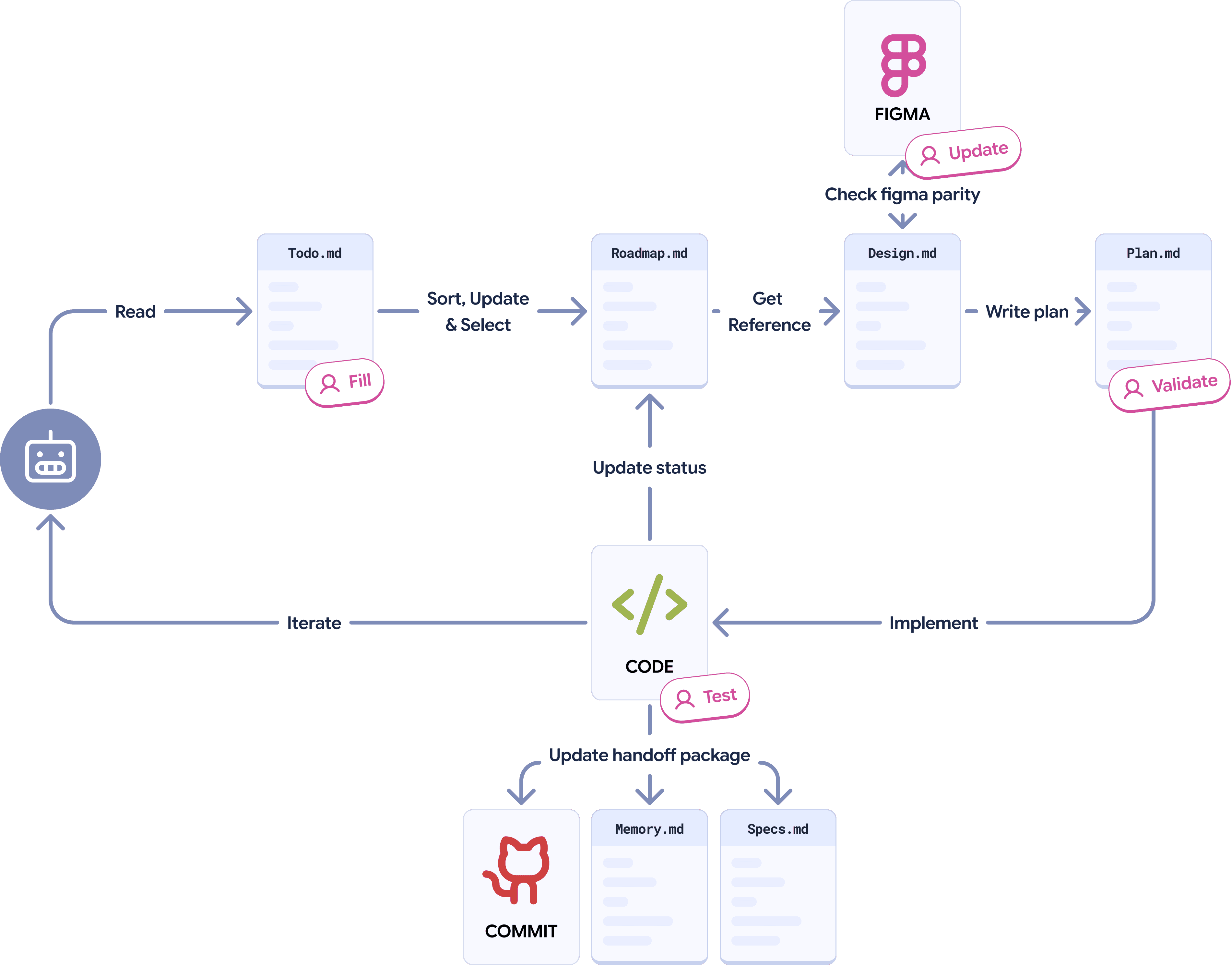
My prototyping loop with coding agents
Agent protocol
Human action

Handoff as structured memory

Design.md

01

UI choices, flows, states, edge cases and interaction logic.

Memory.md

02

Reasoning, trade-offs and mistakes already encountered. Helps the developer — or their agent — understand why a decision exists.

Roadmap.md

03

Priorities, task status and next steps.

Specifications.md

04

Functional rules, constraints and acceptance criteria.

Validated repo

05

Validated prototype used as a behavioral reference.

AI & Product Design — Quentin Gillon